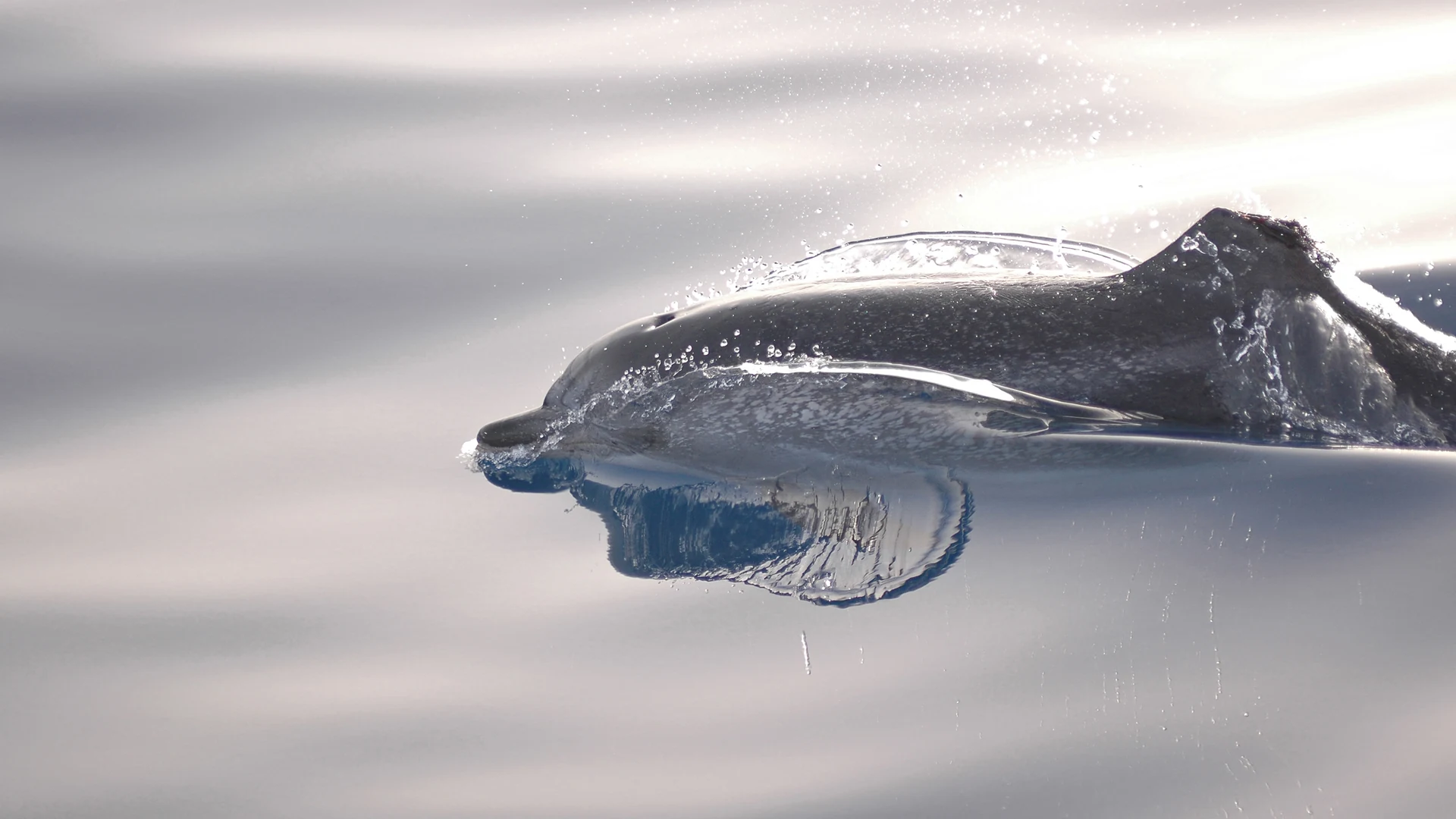
Up to 30 cetacean species have been reported in the waters around Gran Canaria, but four account for almost every sighting a visitor actually gets: bottlenose dolphin, Atlantic spotted dolphin, common dolphin and short-finned pilot whale. The pilot whales are the ones people remember.
The scheduling question answers itself. These are resident, non-migratory populations, so sightings are possible in any month, with a reported peak between April and October. What actually varies is which harbour your boat leaves from, and that is the decision worth spending five minutes on.
Catamaran Dolphin-Watching Cruise with Snorkelling
Total price from
€38
Includes taxes and fees
Powered by GetYourGuide
A three-and-a-half-hour catamaran run off the south-west coast with a snorkelling and swimming stop, and the highest review volume of any dolphin trip on Gran Canaria.
- 3.5 hours, departing the south-west coast
- Snorkelling and swimming stop included
- Resident dolphins and pilot whales, no seasonal window
- Free cancellation up to 24 hours ahead
Which species will you actually see?
Thirty species is the headline number, and it is close to meaningless for planning a morning out. Most of those are rare, deep-water or seasonal visitors nobody on a three-hour boat is realistically going to log.
The four commonly sighted around Gran Canaria are worth knowing by name, because operators use them in their marketing and the differences are visible from a deck:
- Bottlenose dolphin (Tursiops truncatus) – the large, familiar one, and the most reliable sighting
- Atlantic spotted dolphin (Stenella frontalis) – smaller, patterned, often in bigger groups
- Common dolphin (Delphinus delphis) – fast, with a distinctive hourglass flank marking
- Short-finned pilot whale (Globicephala macrorhynchus) – a blunt-headed blackfish, the closest thing to a whale most trips deliver
No operator can guarantee any of them on a given morning. What the resident populations buy you is that a blank trip is bad luck rather than bad timing.
Is there a season for whale watching in Gran Canaria?
Not in the way there is almost everywhere else in Europe. The populations off Gran Canaria are resident and do not migrate away, which removes the seasonal gamble that defines whale watching in the Atlantic further north.
Sources report a peak between April and October, which is worth knowing without over-weighting it. That window tracks sea state and daylight as much as animal presence, and it is also when the boats are busiest.
The practical consequence is that a January trip is a reasonable thing to book, and a July trip needs booking earlier than a January one. Seasonality here is about availability, not about whether the animals are there.
Where do the boats actually leave from?
This is the part that differs most from Tenerife, and it is the thing worth checking on your specific booking. Gran Canaria's trips cluster around the south and south-west: Puerto Rico in the Mogán municipality, Arguineguín and Puerto de Mogán, rather than running out of one dominant harbour.
Pickup zones are correspondingly wide. Operators commonly cover Amadores, Anfi, Arguineguín, Bahía Feliz, Maspalomas, Meloneras, Playa del Águila, Playa del Inglés, Playa del Cura, Puerto de Mogán, Puerto Rico, San Agustín, Taurito and Tauro.
If you are based in Las Palmas rather than the south, the boats are not on your doorstep. The city has its own case for a day, set out in our things to do in Las Palmas guide, but a dolphin trip means heading south-west.
The two cruises worth comparing
Two products dominate the reviews on Gran Canaria, and they are close enough in price that the choice comes down to how long you want to be on the water.
| Catamaran with snorkelling | Dolphin and whale cruise | |
|---|---|---|
| Length | 3.5 hours | 2.5 hours |
| Price | ~€38 | ~€37 |
| Swim stop | yes | not stated |
| Review volume | very high | high |
The three-and-a-half-hour catamaran is the one to book by default: it costs about a euro more, gives you an extra hour on the water and includes a snorkelling and swimming stop. It also carries by far the largest review count of any dolphin trip on the island.
The shorter option, Gran Canaria: Dolphin and Whale Watching Cruise, runs two and a half hours at around €37 and rates slightly lower. It is the better pick if you are travelling with someone who does not love boats, or if the afternoon is already spoken for.
Want a boat day that isn't built around spotting wildlife? Our Gran Canaria catamaran cruise guide covers the lunch-and-watersports trips instead.
What we could not verify about the rules here
One honest gap, because this is the sort of thing guides state confidently and get wrong.
Tenerife's whale-watching waters operate under a published code of conduct with minimum approach distances, observation time limits and a "Blue Boat" certification for licensed operators, and enforcement there is documented and active. Our Tenerife whale watching guide sets out those rules in full.
We have not verified what equivalent licensing or code of conduct applies in Gran Canaria's waters, and we are not going to assume the Tenerife framework transfers across the archipelago. Book through a platform that names the operator, and treat a boat that charges at a pod or sits on top of it as the wrong boat regardless of what the local rules turn out to say.
For the island's other headline day out, a Gran Canaria jeep safari covers the mountainous interior from the same southern resorts these boats leave from.
FAQ – dolphin and whale watching in Gran Canaria
Featured image: Martina Nolte / Wikimedia Commons / CC BY-SA 3.0 de