Most European capitals make you choose between a historic centre and a decent beach. Las Palmas de Gran Canaria gives you a late-15th-century old town and a city beach of more than 3km on opposite sides of the same walkable city. That combination, rather than either half alone, is the reason to give it more than an afternoon.
The distances involved are small and the contrast is not. Vegueta is cobbled, late-Gothic to Renaissance, and holds the largest pre-Hispanic collection in the Canary Islands. Playa de las Canteras, a short journey across town, is regularly named among Europe's best urban beaches. You can reasonably do both in a day.
How far is Las Palmas from the southern resorts?
If you are staying in the south, this is a day trip rather than a base, and a short one. Maspalomas and Playa del Inglés sit roughly 58km from Las Palmas, about 39 minutes' drive on the motorway that runs up the east coast.
That is closer than most visitors assume, and it is the single fact that decides whether the city is worth a day of your holiday. It is not a cross-island expedition. If you are still deciding between a city base and a resort one, our where-to-stay guide walks through that trade-off directly.
The practical consequence is that you can leave after breakfast, do Vegueta before lunch and the beach in the afternoon, and be back for dinner in the resort. A slower version, staying over, gets you the evening in the old town, which is when it is at its best.
Vegueta: the old town the city grew out of
Vegueta is the original settlement of Las Palmas, founded in the late 15th century, and it is a genuine survival rather than a restored quarter. Cobbled streets, late-Gothic through Renaissance architecture, and a scale that makes it walkable in an hour if you do not stop.
You will stop. The quarter holds the cathedral, the city's best museum and the oldest market in the archipelago within a few streets of each other, which is unusual density for a city this size.
Mercado de Vegueta was the first market built in the Canary Islands, and it still trades local and imported produce rather than souvenirs. We could not confirm its current opening hours from a reliable source, so treat it as a morning stop and check locally rather than planning an afternoon around it.
For dinner, Las Palmas holds three of Gran Canaria's five Michelin-starred restaurants – our best restaurants guide covers where to book.
Casa de Colón and the Columbus claim
Casa de Colón is about 500 years old, was rebuilt in 1777, and has operated as a museum since 1952. It is one of the most photographed buildings in Vegueta, and its courtyard is the reason.
The story attached to it needs handling carefully. Tradition holds that Christopher Columbus stayed here in 1492 while one of his ships was repaired, and the museum is built around that association. Treat it as a durable local tradition rather than a documented certainty, because that is what the sources actually support.
The building is worth the visit regardless of whether Columbus slept in it. Canarian courtyard architecture at this scale is not something the resort coast has anywhere.
El Museo Canario, and a word about who the collection is actually about
El Museo Canario was founded in 1879 and holds the largest pre-Hispanic collection in the Canary Islands, covering roughly 500 BC to the 15th century across 11 rooms: pottery, skeletal remains, mummies. It also holds what is described as the world's largest collection of Cro-Magnon skulls.
One point of precision that most guidebooks get wrong. The pre-Hispanic people of Gran Canaria are properly called canarios, or aboriginal Canarians – not Guanches. "Guanche" is specific to Tenerife's own pre-Hispanic population, and using it as a blanket term across the archipelago is an error, however often you see it in tourist material.
Opening hours are longer than most Spanish museums manage:
- Monday to Friday: 10:00 to 20:00
- Saturday and Sunday: 10:00 to 14:00
The cathedral: hours, and a ticket price nobody agrees on
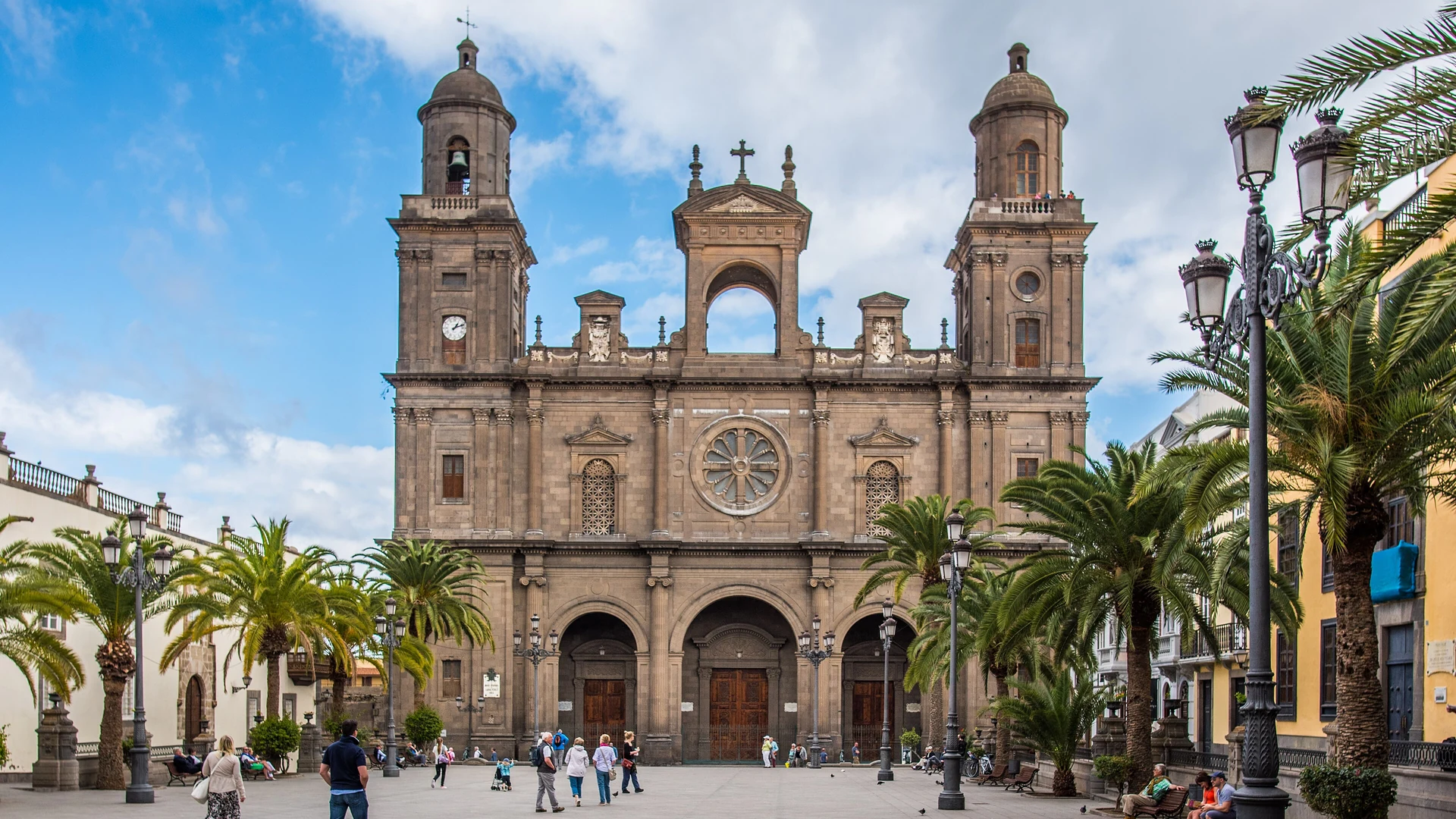
Construction of the Catedral de Santa Ana began in 1497 and was not completed until the end of the 20th century, which is why the façade reads as a mix of neoclassical, Gothic and Renaissance rather than one coherent style. Five centuries of interruption will do that.
Published visiting hours are Monday to Friday 10:00 to 16:30 and Saturday 10:00 to 13:30, which rules out a lazy start if the cathedral is the reason you came.
The tower is the part worth paying for either way, because it puts the old town's roofline and the harbour in the same view.
Playa de las Canteras: the reef is the whole story
Playa de las Canteras runs more than 3km along the city's western side and is routinely listed among the best urban beaches in Europe. What makes it work is not the sand.
A natural offshore lava reef, La Barra, sits across the bay and acts as a wavebreak. It holds the water inside it calm and shallow, which is why a beach in the middle of a city of this size is genuinely swimmable and why there is enough marine life for snorkelling. Outside the reef, the same beach delivers surf and bodyboarding.
The beach is in the city, not a drive from it, which is the point. You can be in the old town at noon and in the water by two.
With children, and when the weather turns
The beach handles most of this on its own, given the reef makes the water calm. For the days it does not, Poema del Mar is the city's aquarium and the obvious indoor fallback.
It runs at around €29 per person on GetYourGuide, where it is highly rated across several thousand reviews. Skip-the-line entry is bookable in advance, which is worth doing on a wet afternoon when everyone else has the same idea. Planning a wider trip with children? Our Gran Canaria with kids guide covers the water parks and Palmitos Park too.
For families basing themselves in the south and coming up for the day, the timing works better in reverse: aquarium or museums in the morning, beach in the afternoon when the city has warmed up.
How long do you need in Las Palmas?
One full day covers the headline version: Vegueta in the morning, lunch near the market, Las Canteras in the afternoon. Two days lets you do the museums properly and see the old town in the evening.
If you are choosing between the city and the island's other days out, the honest answer is that Las Palmas is the one that looks least like a holiday brochure and most like a place people live. That is either exactly what you want or exactly what you do not.
For the rest of the island, a Gran Canaria jeep safari reaches the mountainous interior in a day, and dolphin and whale watching works off the south-west coast year-round. Comparing islands rather than days out? Our things to do in Tenerife guide covers the equivalent set on the bigger island.
Nearer to hand, Arucas is a short drive north with a banana estate and a rum distillery – our banana, rum and coffee tour guide covers both. Santa Brígida, just outside the city, has Gran Canaria's own wine country – our wine tasting guide covers the tours.
FAQ – visiting Las Palmas, Gran Canaria
Featured image: Bengt Nyman from Vaxholm, Sweden / Wikimedia Commons / CC BY 2.0