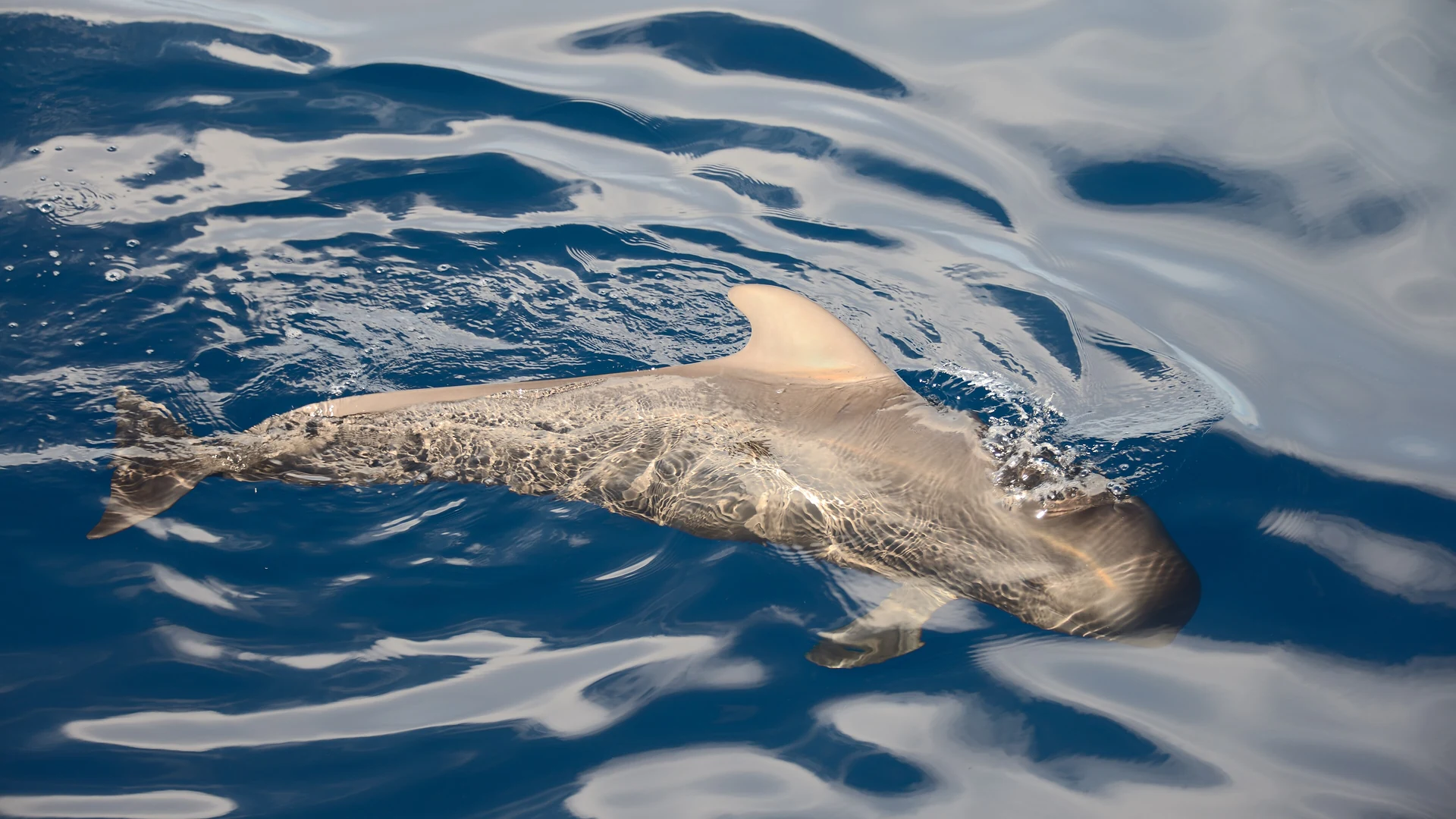
The water off Tenerife's south-west coast holds a resident, year-round population of short-finned pilot whales, estimated at somewhere between 250 and 400 animals depending on the study you read. The Teno-Rasca Special Marine Conservation Area is identified in the research literature as having one of the highest densities of resident whales anywhere in the world.
That is why this is not the seasonal lottery whale watching is almost everywhere else in Europe. A 1.5 to 2 hour trip costs €28 to €30 per person and leaves from one of three ports – the only real decision left is whether the boat you board obeys the rules.
Travelin' Lady: Eco Yacht Whale & Dolphin Safari + Swim
Total price from
€30
Includes taxes and fees
Powered by GetYourGuide
A 1.5-hour eco-yacht safari from Los Cristianos, small group, with a swim stop away from the animals rather than a mass-market catamaran.
- Leaves Los Cristianos, 1.5 hours
- Small-group eco-yacht, not a big catamaran
- Open-water swim stop included, away from the whales and dolphins
- Live guide in English, French, Spanish and Italian
Why the sightings are not a lottery here
Most European whale watching sells you a chance. Tenerife sells a resident population that does not migrate away, which is a different product entirely.
The evidence is unusually solid. A study drawing on 1999–2012 data logged 1,081 whale sightings across 70,620km of survey transects over 1,782 survey days and found strong evidence of an island-associated subpopulation: a core group of about 50 particularly resident individuals, and over 400 photo-identified animals in Tenerife's southern waters.
Bottlenose dolphins share the coast, and Costa Adeje operators describe five dolphin species here – bottlenose, striped and common among them. That count comes from operators rather than a survey, so treat it as a strong indication rather than a headcount.
How to tell a licensed boat from an illegal one
This is the part the listings do not tell you, and it is not theoretical. Inspectors have filed more than 1,700 sanction reports against illegal, unlicensed whale-watching operators in Tenerife since 2018.
A legal boat carries the "Blue Boat" (Bandera Azul) certification, and the rules it works under are public, published by the island's own tourism authority.
- Minimum approach distance: 60 metres
- Engines off once an animal is within 500 metres
- Maximum observation time: 30 minutes
- Maximum three boats in the protected zone at any one time
- Prohibited: swimming with, touching or feeding the animals, littering, excessive noise
If a boat charges at a pod, sits on top of it with the engine running, or is still there after half an hour, you are on the wrong boat. Booking through a platform that names the operator is the cheapest way to avoid the quayside touts.
If the no-chase policy is the whole reason you are booking rather than just a box to tick, Eco No-Chase Respectful Whale & Dolphin Encounter sells that as its entire premise. It runs 1.5 hours from Los Cristianos with Vision Submarine, 4.6★ from 14,817 reviews.
Which port your trip actually leaves from
The association between Los Gigantes and whale watching is strong enough that most guides state it as a blanket fact. It is not one. The trip above leaves from Los Cristianos, and so does the no-chase option in the previous section.
Of the three licensed trips we checked, only Los Gigantes: Dolphin & Whale Watching Cruise with Swim Stop sails from Los Gigantes harbour itself. Run by Flipper Uno, it takes 2 hours, rates 4.7★ from 5,348 reviews, and names the Teno-Rasca sanctuary in its own listing.
| Port | Trip length | What it suits |
|---|---|---|
| Los Cristianos | 1.5 hours | Short trip, southern resort bases |
| Puerto Colón (Costa Adeje) | up to 5 hours | Catamaran runs with lunch and a swim stop |
| Los Gigantes | 2 hours | Sailing under the cliffs on the same trip |
The reason Los Gigantes keeps coming up is the long option: five-hour catamarans leave Puerto Colón, board around 11:00 at jetty number 9, and spend the first 2.5 hours reaching the whale habitat before turning towards the cliffs. You see the cliffs without departing from them.
Where you are staying should settle it. Los Cristianos and Costa Adeje are both a short run from Tenerife South, as the Tenerife airport transfer guide sets out; Los Gigantes is a real drive west.
When to book, and what a trip is really like
There is no season to wait for. Availability is the thing that moves: the consensus across booking platforms is that the most popular cruises sell out in July, August, Christmas and Easter – industry consensus rather than a published figure, but consistent enough to act on.
Book ahead in those windows, and go early in the day if sea state matters to you. Afternoons on this coast pick up wind, and a 1.5-hour boat feels it more than a catamaran does.
If you would rather be in the water than on it, the kayak and snorkelling tours work the same coast at turtle depth. The things to do in Tenerife guide sets out where a boat day fits against the volcano and the parks, and the best hotels in Tenerife guide explains why nearly every base sits on this strip.
FAQ – whale watching in Tenerife
Featured image: Cayambe / Wikimedia Commons / CC BY-SA 3.0