Most Tenerife towns are sold on their beach or their old streets. Candelaria is sold on neither. The Basílica de Nuestra Señora de Candelaria holds the patron saint of the entire Canary Islands archipelago, which makes this east-coast town a destination for the other islands rather than only for its own.
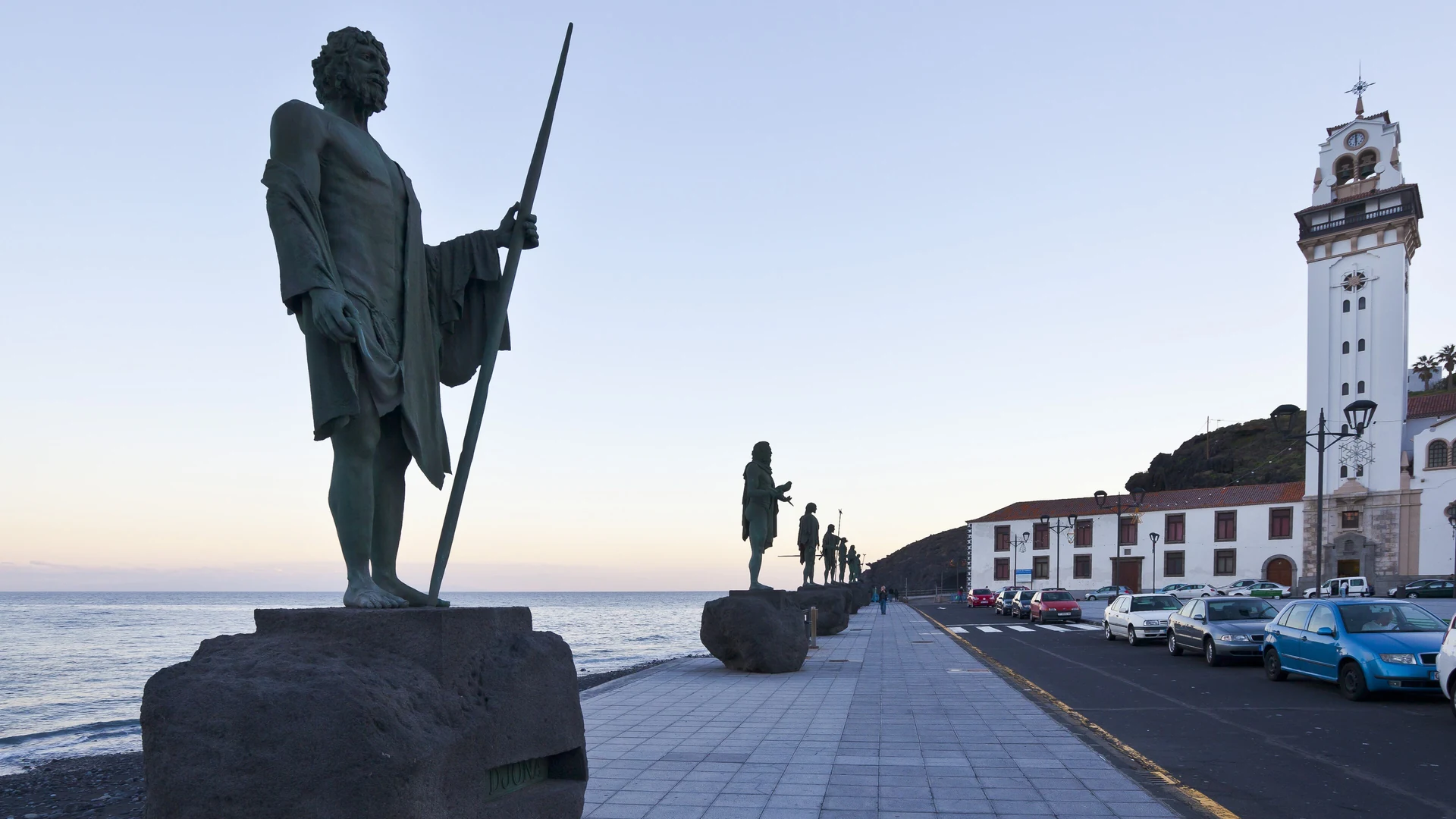
The second reason to come stands outside, on the seafront, and costs nothing. Nine bronze statues of Guanche chiefs line the Plaza de la Patrona de Canarias, one for each of the historic territories Tenerife was divided into before the Spanish conquest. They are the best free thing to look at anywhere on this coast.
Why does Candelaria matter to islands that are not Tenerife?
Patron sainthood in the Canaries is usually island-level. The Virgin of Candelaria is not: she is patron of the whole archipelago, and the basilica that houses her is here rather than in the capital or on any of the other six islands.
That is the whole explanation for the town's scale and its calendar. A church with archipelago-wide patronage draws people who have to cross open water to reach it, which is why the big August event is described as a pilgrimage rather than a fiesta.
It also explains why Candelaria feels disproportionate on a first visit. The square in front of the basilica is far larger than the resident population would ever need, because it is built for the days when everyone else arrives.
The nine Guanche chiefs on the seafront
The sculptures are officially the Conjunto Escultórico de los Menceyes, by the sculptor José Abad, and the bronze versions standing there now were inaugurated on 13 August 1993. They replaced earlier stone figures that the coastal exposure had damaged.
A mencey was the chief of a menceyato, one of the territories Tenerife was split into before the conquest, and there is one statue per territory: Abona, Adeje, Anaga, Daute, Güímar, Icod, Tacoronte, Taoro and Tegueste. Several of those names are still on the map as towns and districts today.
They stand in the open on the seafront, free to visit at any hour, with the Atlantic directly behind them. Early morning and late afternoon are when the light works and the square is not full of coach parties.
Visiting the basilica: hours, and a price nobody agrees on
The published visiting hours are narrower than most visitors expect, and they exclude the day you would most likely be free.
- Monday to Friday: 10:00 to 18:00
- Saturday: 10:00 to 14:00
- Sunday: closed to visitors
Those are the hours the Tenerife tourism listings publish for visits, and they read as sightseeing hours rather than service times, so a working church may well be open for mass when it is closed to tourists. Turning up on a Sunday expecting a look round is the mistake to avoid.
Two festivals, and which one is which
Candelaria has two dates in the calendar and guides routinely merge them into one. They are separate events with different characters.
The Procession of the Candles falls on 1 and 2 February and is the smaller of the two. The lights of the town are extinguished for it, which is the entire point of the name and the reason it looks nothing like the summer event.
The main pilgrimage runs from 13 to 15 August and is much bigger. This is the one that fills the plaza, and it is worth deciding deliberately whether you want to be in Candelaria for it or somewhere else on the island entirely.
If your dates are flexible, the best time to visit Tenerife guide sets out what August does to the island's crowds and prices more generally.
How long you need, and what to pair it with
Candelaria is a half-day at most, and honestly closer to two hours: the statues, the basilica, a coffee on the square and the seafront walk between them.
That makes it a stop rather than a destination, and it pairs naturally with the east coast and the capital rather than with the southern resorts. Nothing here needs booking, nothing here sells a ticket you must buy in advance, and the whole outdoor half of the visit is free.
For the town that pairs best with it as a full day of Canarian architecture, the balcony streets of La Orotava sit on the opposite, northern side of the island and cover the domestic version of the same period. If you want the volcano instead, a Teide stargazing tour starts late enough that an afternoon in Candelaria fits ahead of it.
Getting to Candelaria
The town sits on the east coast between the southern resort strip and Santa Cruz, on the main motorway corridor, which makes it one of the easier stops on the island to reach by car.
By bus, TITSA route 126 connects Candelaria with Santa Cruz. We are not going to name a direct route number from Costa Adeje or the southern resorts, because we could not confirm a single clean service that runs it – check the operator's own journey planner for your specific starting point rather than trusting a route number from a guide.
Our getting around Tenerife guide explains the ten+ travel card and the scan-on-exit rule that catches out first-time TITSA passengers, both of which apply to this journey. For the wider picture of where Candelaria sits among the island's headline sights, see the things to do in Tenerife guide.
FAQ – visiting Candelaria, Tenerife
Featured image: Diego Delso / Wikimedia Commons / CC BY-SA 3.0