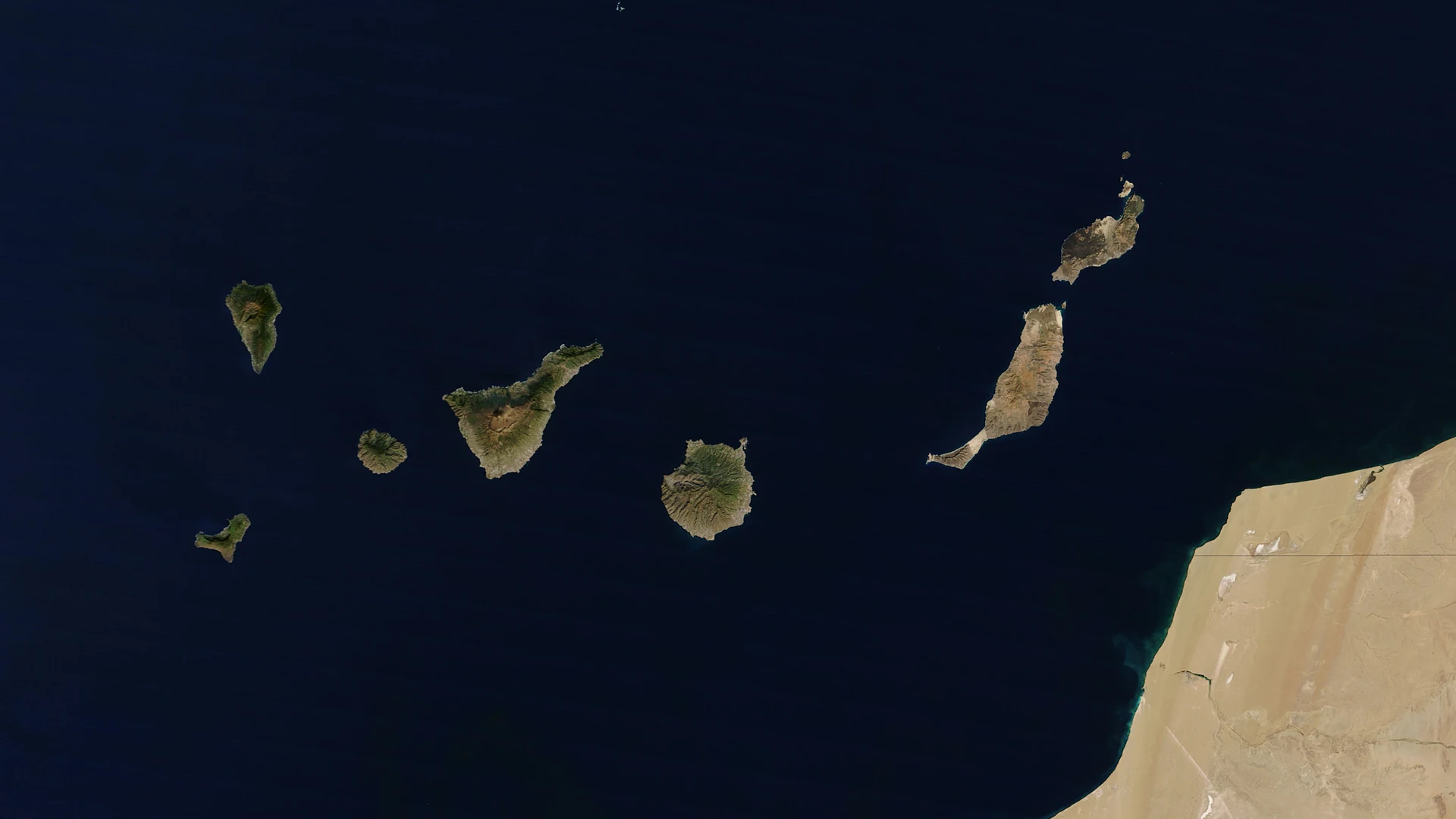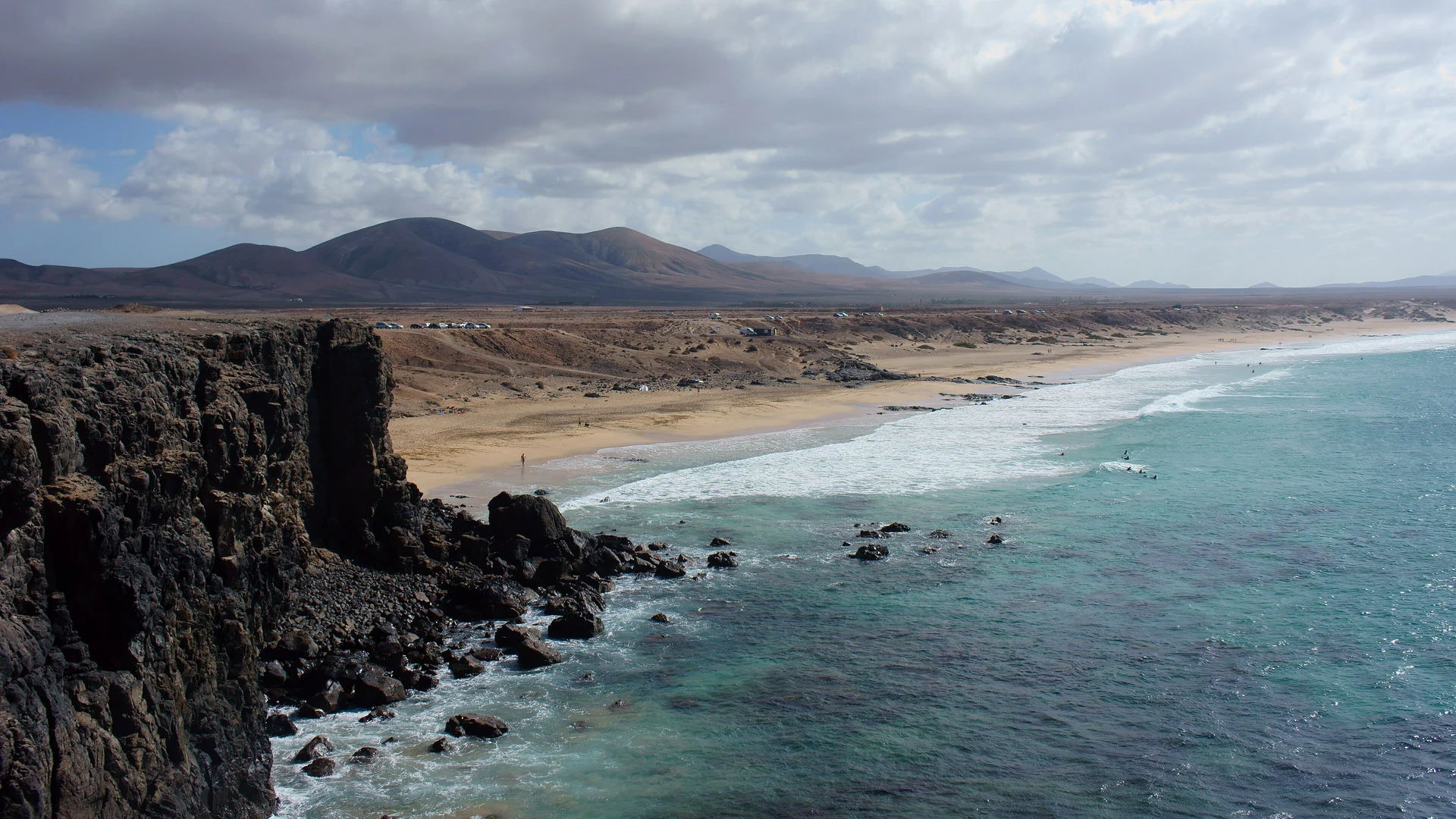
Any month works on the Canary Islands' coasts: winter highs sit between 21°C and 22.5°C at all six coastal stations compared here. What changes from island to island is rain and sunshine. From December to February, Fuerteventura, Lanzarote, Tenerife's south and Gran Canaria's east coast record 45–75mm, while La Palma's east coast gets 165mm and under five hours of sun a day. Climb inland and the rules change. September works at every station in the table.
The islands on one set of station averages
Every figure below comes from Climates to Travel's station averages for 1991–2020, checked on 23 September 2026. Winter means December to February, and the source rounds rainfall to the nearest 5mm.
| Island (station) | Winter high | Winter rain | Winter sun | August high |
|---|---|---|---|---|
| Fuerteventura (airport) | 21.3°C | 45mm | 6.5h a day | 27.9°C |
| Lanzarote (Arrecife) | 21.5°C | 50mm | 6.7h a day | 29.4°C |
| Tenerife south (airport) | 22.5°C | 65mm | 6.8h a day | 28.6°C |
| Gran Canaria east (airport) | 21.6°C | 75mm | 6.3h a day | 27.9°C |
| El Hierro (airport) | 21.4°C | 90mm | 5.3h a day | 26.1°C |
| La Palma east (airport) | 21.4°C | 165mm | 4.8h a day | 26.8°C |
| Tenerife hills (La Laguna, ~540m) | 16.8°C | 230mm | 5.2h a day | 25.8°C |
Read the station names as carefully as the numbers. The first six are coastal airports or towns; La Laguna is a hill town behind Santa Cruz, included because it shows what altitude on a windward slope does. The Gran Canaria station is on the east coast near Ingenio, not in the Maspalomas resort area, and the La Palma one covers the east, not the sunnier west.
Two gaps are worth stating plainly. La Gomera has no station on this source, and neither does Tenerife's north coast around Puerto de la Cruz, so neither appears in the table rather than being guessed.
Which Canary Island is warmest and driest in winter?
On the coast, temperature barely separates them; rain and sunshine do. Winter highs run from 21.3°C at Fuerteventura's airport to 22.5°C at Tenerife South, a spread of barely a degree. Fuerteventura is the driest, with 45mm of rain across December, January and February, and Lanzarote is close behind at 50mm.
Tenerife's south coast gets the most winter sunshine in the table, 6.8 hours a day, with 65mm of rain. At the other end, La Palma's east coast records 165mm and 4.8 hours of sun a day, the same warmth under far more cloud. El Hierro sits between the two, with the mildest winter nights of the six, averaging lows of 17.4°C.
Altitude is the bigger divide. La Laguna, on Tenerife's windward northern slopes, averages 16.8°C by day and 230mm of rain in winter, because the moist north-east trade winds drop their rain on the high islands' north-facing slopes. Our guide to choosing a Canary Island explains what each island is like to stay on.
One catch in the east: the sea around Fuerteventura and Lanzarote is the coolest in winter, at 18°C in February, against 19–19.6°C off Tenerife, La Palma and El Hierro. Dry air does not mean warm water there.
When is it windiest?
In summer. The official Canary Islands tourism site says the trade winds' influence is greater over the summer months, with the most extreme conditions in June, July and August.
The same source names where they accelerate hardest: east of Gran Canaria and Lanzarote, and south-east of Fuerteventura. Sotavento, on Fuerteventura's south-east coast, is where international windsurfing competitions are held for exactly that reason.
For a beach holiday, that means summer afternoons can be breezy on the exposed coasts of the eastern islands. For windsurfers and kitesurfers, it means the best season is the one most families book anyway.
Which island is hottest in summer?
Lanzarote: Arrecife averages 29.4°C in August and 28.5°C in September, the highest figures in the table. Tenerife South follows at 28.6°C in August, then Gran Canaria's airport and Fuerteventura at 27.9°C. El Hierro, at 26.1°C, and La Palma's east coast, at 26.8°C, have the mildest summers of the coastal stations.
Summer is dry everywhere. All six coastal stations record 0mm of rain in both July and August, and even hilltop La Laguna manages only 5mm a month, so the summer choice is about heat and wind rather than rain.
When is the sea warmest?
September, and the west is warmer than the east. The sea reaches 24°C off Tenerife's south, La Palma and El Hierro in September, but only 22.5°C around Fuerteventura and Lanzarote, with Gran Canaria in between. Off La Palma and El Hierro it is still close to 24°C in October.
It is coolest in February and March, between 18°C in the east and about 19.5°C off El Hierro, which is swimmable for most people and bracing for many. The sea lags the air by about two months, so late summer and early autumn are the swimming season across the whole archipelago.
Hiking, crowds and carnival
Walking is best from autumn to spring, when the air is cooler for climbing. Winter brings its own limit at altitude: on Tenerife, snow on the summit of Teide is normal in winter, and the access road closes when it falls.
Crowds follow school holidays more than weather. Christmas and New Year, February half-term, Easter and the summer holidays are the expensive weeks, and winter is also high season for northern Europeans escaping the cold. Carnival season fills hotels in February and into March on Tenerife and Gran Canaria.
Our island pages have the month-by-month detail: the best time to visit Tenerife and the best time to visit Gran Canaria, with the full monthly tables in our Tenerife weather by month and Gran Canaria weather by month guides.
So which month should you book?
- Winter sun, December to February: Fuerteventura, Lanzarote or Tenerife's south coast, the driest and sunniest winter stations in the table
- The warmest sea: September, and on the western islands if the water matters most
- Walking the green west: April and May, when La Palma and El Hierro are far drier than in winter and still cool enough to climb
- Wind and kite sports: June to August, on Fuerteventura's south-east coast
- Fewer crowds: outside the school holidays, with the weeks after Easter and late September the usual sweet spots
If you can only move one thing, move the island rather than the dates. A December week on Fuerteventura and a December week on La Palma's east coast are the same temperature and a very different amount of sunshine.
FAQ – when to visit the Canary Islands
Featured image: Jarek Prokop / Wikimedia Commons / CC BY 3.0