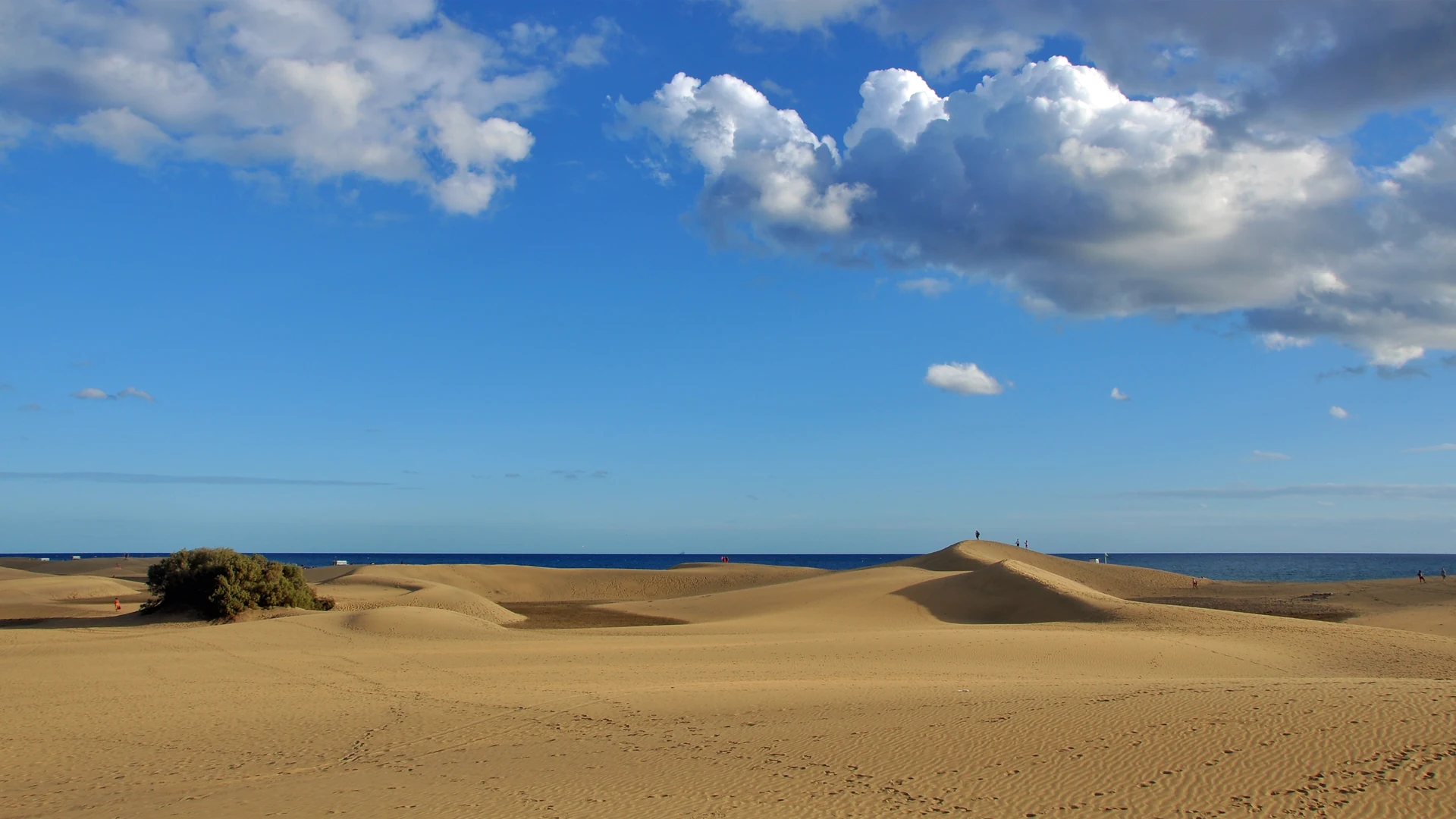
The Maspalomas dunes are free, open every day and a short walk from the resort, which is exactly why so many visitors wander into them as if they were a beach. They are not. Since 22 May 2020, walkers must stay on about 8km of marked trails, and leaving them carries a fine starting at €150.
That rule is no longer a sign people ignore. In August 2026 the Cabildo de Gran Canaria stepped up enforcement with drone patrols and multilingual loudspeaker warnings to keep visitors on the paths. The paid activity most visitors book here is the camel ride, which runs mornings only, for about 30 minutes, at €18 per adult.
Maspalomas: Guided Camel Ride in the Maspalomas Sand Dunes
A guided 30-minute camel ride across the Maspalomas dunes, meeting at the camel station on Paseo Charca Maspalomas near the lagoon and lighthouse.
- 30-minute guided ride through the dunes
- Two-seater saddles, so pairs ride together
- Children under 3 ride free with a parent
- Maximum rider weight 100kg
Total price from
€18
Includes taxes and fees
Powered by GetYourGuide
What are the rules in the Maspalomas dunes now?
The Dunas de Maspalomas are a 403.9-hectare Special Nature Reserve in San Bartolomé de Tirajana, and part of the EU's Natura 2000 network. That status is why the rules exist, and it is why rangers enforce them rather than just posting them.
The core rule is simple. You must stay on the marked trails. Off-trail walking is banned, and so is sunbathing among the vegetation. Vehicles, camping, fires and dogs are not allowed, and neither is taking sand, plants or animals away with you.
The penalties scale with the damage:
- Leaving the marked paths: from €150, with a 20% discount for paying promptly
- Serious vegetation damage or building structures: fines reported up to €600
- Large-scale environmental damage, such as sand removal: up to €600,000
Enforcement is real. Rangers have fined a tourist who strayed only a few metres from the path, and around 200 infractions for illegal dune transit were recorded in 2024, with around 200 more issued so far in 2026.
One more date worth knowing: on 11 June 2026 the Canary Islands' official bulletin opened a 17-month procedure to draw up a new natural resources plan for the reserve. Reports on it say no closure or new entry rule follows immediately, so nothing changes for a visit this year.
The camel ride: what €18 gets you
The camel station sits on Calle Oceanía, near La Charca lagoon and the Faro de Maspalomas, and is operated by Camello Safari Dunas, which describes itself as the official camel ride in the reserve. The GetYourGuide listing meets at the same spot: from the lagoon, about a five-minute walk along Calle Oceanía.
The operator's own tariff and the GetYourGuide price match, which makes the booking decision easy:
| Rider | Price |
|---|---|
| Adult | ~€18 |
| Child, 3–12 | ~€13 (operator's tariff) |
| Under 3, with a parent | free |
- Ride length: about 30–35 minutes
- Operating hours: mornings, roughly 09:00–14:15, daily
- Departures: every 15–30 minutes
- Weight limit: 100kg per rider
Afternoons are set aside for the animals' care and rest, so there is no sunset camel ride in the dunes. The window closes at about 14:15 for the last ride.
Booking ahead is less about price than about the slot. With a morning-only operation, a ride you meant to take "later" simply does not happen. The camel ride on GetYourGuide holds a time for you; check the child price on the listing, since the €13 figure is the operator's own rate.
Where is the nudist area on Maspalomas beach?
The clothing-optional section is roughly in the middle of Playa de Maspalomas, the long beach running along the seaward edge of the dunes. It is not at the lighthouse end, which is a common assumption and the wrong one.
Sources describe the beach as informally zoned: families closer to the Faro, naturists along the central stretch, and a lively LGBTQ+ section towards Playa del Inglés. Reaching the naturist zone takes about twenty minutes' walk along the shore from the lighthouse.
Guides quote different beach kiosk numbers for where it starts and ends, and they do not agree, so treat "the middle stretch, between the lighthouse and Playa del Inglés" as the reliable description. No 2025–2026 source reports any ban or closure of the Maspalomas naturist area, and it is treated as an established, tolerated part of the beach.
The dune rules still apply there. Sunbathing among the vegetation behind the beach is one of the specifically banned behaviours, so stay on the sand.
La Charca and the Faro: what you can and cannot do
La Charca de Maspalomas is a 22-hectare coastal lagoon, and one of the most important bird habitats in the Canary Islands. Its shoreline is fully closed to the public.
You see it from a viewing path with information panels along its edge, and the Avenida del Oasis side is the recommended viewpoint. You walk around the lagoon; you never go down to the water.
The Faro de Maspalomas, the lighthouse at the western end of the beach, is free to enter, but the tower itself is not open to climb. What you can visit is the building at its base: a small museum on local history, crafts and traditions, and a viewing terrace about three floors up.
- Hours: 10:30–17:00 daily, 11:00–17:00 in summer
- Entry: free
- Tower: closed to visitors
Some visitors report finding the museum unexpectedly shut during posted hours, so do not make it the only reason for the trip.
When should you walk the dunes?
Avoid 12:00 to 16:00 in summer. The sand can exceed 50°C in the middle of the day, and there is no shade or water anywhere inside the reserve.
The best answer is sunrise. Arriving about 30 minutes before sunrise gives you the coolest sand, the best light for photographs and your pick of the car park. Plan on 1.5 to 2.5 hours for a dunes walk from the Faro side.
UV levels across the Canary Islands run very high to extreme, so SPF 50+, a hat and a full bottle of water each are the minimum. Late afternoon also works, but it is warmer. Our Gran Canaria weather by month guide shows how hot each month gets on this coast.
How do you get there?
By car, park at the Faro de Maspalomas car park, which is paid at around €1.50 an hour, or at the paid Palmeral car park on the north side of the dunes. Street parking in Maspalomas town is the fallback. No vehicles are allowed inside the reserve.
In summer, both car parks fill after about 10:00. Arrive before 09:00, which fits the sunrise advice above anyway.
By bus, the Faro de Maspalomas is well served by Global. From Playa del Inglés, lines 5 and 40 stop by the Faro and dunes area. From Puerto Rico, Mogán's tourist office lists lines 32, 33 and 39 on the coastal corridor towards Playa del Inglés; check the Global app for which one continues to the Faro stop and where to change, since routes and frequency vary by line.
If you have not yet booked a base and the dunes are high on the list, Maspalomas and Meloneras put them on foot. Our where to stay in Gran Canaria guide compares them with the other bases on the island, or see our best hotels in Maspalomas guide for named properties.
For a second morning on this coast, dolphin and whale watching trips leave from the south-west harbours year-round.
FAQ – visiting the Maspalomas dunes
Featured image: Marc Ryckaert (MJJR) / Wikimedia Commons / CC BY 3.0